Sabtu, 21 April 2012

Tibetan Festivals


tibetan festival
tibetan festival tibetan festival

Tibetan new year


It is the greatest festival in Tibet. In ancient times when the peach tree was in blossom, it was considered as the starting of a new year. Since the systematization of the Tibetan calendar in 1027 A.D., The first day of the first month became fixed as the new year. On the new year's the families unite " auspicious dinner" is offered and the auspicious words " tashi delek" are greeted. It is the most colorful festival of Lhasa. Monlam (great prayer festival of Lhasa)

Known also as the great prayer festival, this is held midway through the first lunar month. An image of maitreya from the jokhang is borne around the barkhor, attracting enthusiastic crowds of locals and pilgrims.

Saga dawa festival (May or June) It is the holiest in Tibet, there memorable occasions coincide on this day, buddha's birth and buddha's enlightenment. Almost every person within Lhasa join in circumambulations round the city and spend their late afternoon on picnic at "dzongyab lukahng" park at the foot of potala.

Gyantse horse race & archery (May or June) Horse race and archery are generally popular in Tibet, and gyantse enjoys prestige of being the earliest in history by starting in 1408. Contests in early times included horse race, archery, and shooting on gallop followed by a few days' entertainment or picnicking. Presently ball games, track and field events, folk songs and dances, barter trade are in addition to the above.

Shoton festival (august) It is the opera festival and the greatest festivals in Tibet. In ancient times pious folks went into mountain hermitages of which yoghurt was served for meal followed by entertainment of folk songs and dances. Since 7th century, opera performances were held for days in norbu lingka. Presently, opera contests and distribution of prizes are held for seven days.

Harvest festival (September) The farmers in Lhasa, gyantse and shangnan to celebrating their bumeer harvest in this time. During that time, people enjoy with horse racing games, costume fashion show, songs and dance archery and picnic etc.

Bathing week
It is believed when the sacred planet Venus appears in the sky, the water in the river becomes purest and cure diseases. During its appearance for one week in the sky, all the people in Tibet go into the river for bathing.

Changtang chachen horse race festival(10 august)
As the most important festival in north Tibet during the golden season on the grassland, thousand of herdsmen throng to nakchu riding fine horses, and carrying the local products. They form as city of tens south of nakchu town. There will be thrilling horse race, archery and demonstrations of horsemanship. Songs and dance troupes from all part of Tibet will add to the fun.

Ganden festival

On the 15th day of the 6th Tibetan month, 25 precious articles belonging to ganden monastery, which are normally locked in their treasure house, are display
ed in the main shrine hall. A grand offering ceremony accompanies the display. These articles consist of the images of the sixteen arhats, akshobhya, the secret assembly, the four great kings, the upasaka and hashang imaged.

Rabu, 04 April 2012

Tin Hau

People in China alawys celebrate Tin Hau.
The Tin Hau festival is celebrated on the 23rd day of the Third Moon (late April, early May). The day is set aside to honour a young girl named Mo Niang. She was re-named Tin Hau, the "Queen of Heaven", and is the "Mother" of boat people and sailors.
Tin Hau was born in Fukien in the year 1093. Legend tells a story that she bid her father and brothers farewell as they went off fishing. She went to sleep and had a dream they were drowning. She flew over the waters on clouds and rescued her family just as they were about to drown.
Tin Hau is also said to have been able to predict storms and sea traveller's fortunes. She died at the age of twenty and received her title shortly afterwards.
There are numerous shrines and temples dedicated to her spirit. On her birthday, the boat people, sailors and those who live on the waterfront, sail to Da Miao (the Great Temple) in Joss HoUse Bay and pay their respects to the goddess, praying for safety in the coming year.
alaways celebrate Tin Hau.
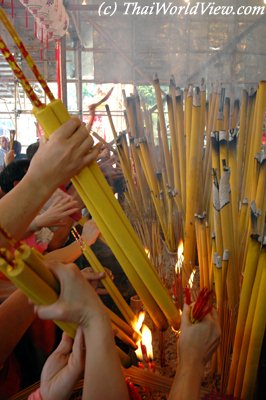
Light up joss sticks
Hundreds of people rush to light up the first joss sticks and offer up them to the goddess Tin Hau.
Light up joss sticks
To protect fishermen and seafarers, local people offer up joss sticks, small sums of money and oranges to the goddess Tin Hau.
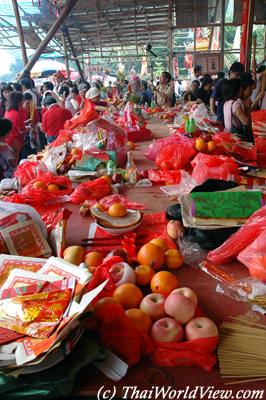
Oranges, suggestive of immortality and good fortune, are piled high. Roast suckling pigs protect against ill health and bad luck. Persimmons represent joy. Pomegranates, with their endless seeds, denote fecundity.
Offering to Tin Hau

Offering to Tin Hau
During Tin Hau festival, joss sticks, suckling pigs and white wine are usual offerings.
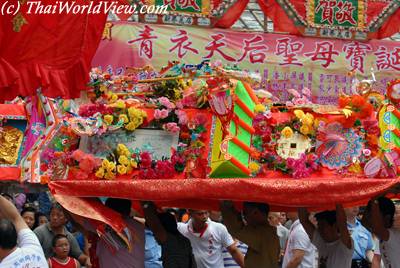
Carrying Fa Pau
These villagers are carrying a 6-meter high "Fa Pau", floral paper offerings, for celebration of Tin Hau festival.
Carrying Fa Pau
Tin Hau can forecast the weather and save people from shipwrecks. However, since the decline of the local fishing industry and advances in meteorology, the goddess has expanded her role to watching over families. Hong Kong parents often offload the responsibility of raising their own children to the goddess by making her their godmother.
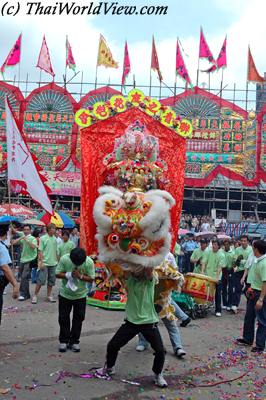
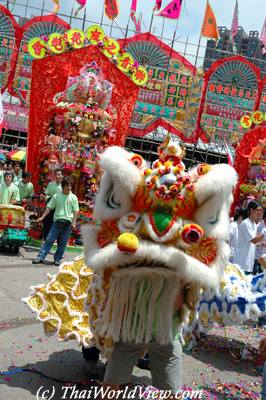
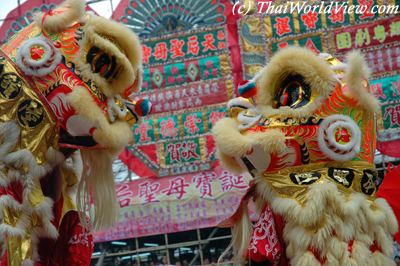
The beating of drums is the background music for the fearsome dancers. Two people wear a colourful paper-mache lion head. With full coordination they move through graceful gestures, expressing the feelings of the lion. The lion may be bashful, playful or even angry and the steps of the performers convey this mood to the audience.
Lion dance

Lion dance
Local people buy paper spinning wheels which will bring good luck to their home.
Lion dance
This lion comes to worship Tin Hau. The lion shall not show its bottom to the goddess so it has to walk backwards.
Lion dance
On the festive day, believers perform lion dance and drums, carry other items and offer them to Tin Hau deity at Tin Hau Temple.
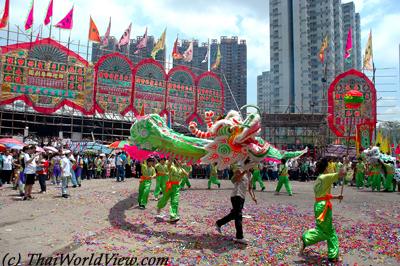
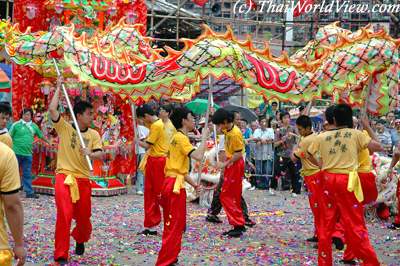
Spectacular parade of lion and dragon dancers goes to the local Tin Hau Temple. There the village teams collect the "Fa Pau", floral paper offerings, and perform in the temple yard.
Dragon dance

Dragon dance
The most famous festivities for Tin Hau birthday happen in Yuen Long Town with a spectacular parade through the streets. 25 teams of performers, including lion dancers, dragon dancers and other artists formed a procession. From the stadium the teams march back to the Tin Hau Temple at Tai Shue Ha, where tribute is paid to the statue of Tin Hau. This is followed by drawing lots for the right to carry the most prestigious "Fa Pau" next year.
Dragon dance
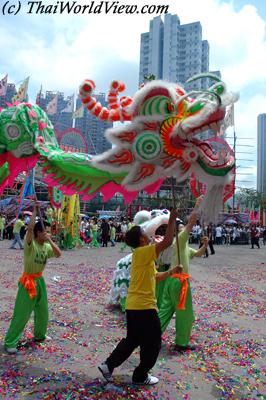
Beautiful dragon dance worshipping Tin Hau performed on Tsing Yi island. In the background, a series of "Pai Lau" or traditional decorative billboards have been erected.
Dragon dance
The Yuen Long parade, in the New Territories, include colourful floats and lion dances. The procession of parade through the streets takes about two hours.
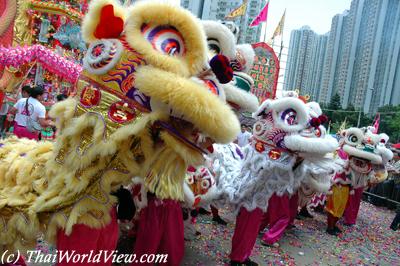
When two communities meet, their lions bow to each other's Tin Hau statues. Sometimes the lions greet each other and have a dance together before they move on.
Lions

Lions
The Tin Hau birthday festival culminates in a procession and is characterised by floral paper offerings known as "Fa Pau".
Dragon dance
A grand procession features golden dragons, colorful lions and unicorns, and participating teams from local villages and organisations.
Dragon dance
Tin Hau birthday events are organised by local Celebration Committees and local Rural Committees.
Tin Hau is worshipped in more than 70 temples in Hong Kong. Famous temples include the Tin Hau Temple in Stanley, which was restored in year 2000.
Lions


Dragon Boat Festival

In China people always celebrate dragon boat. This celebrate in the 5th day of the
5th lunar month .
Dragon Boat Festival people in China mean it Duanwu Festival.

History about Duanwu Festival

Origin

The Duanwu Festival is believed to have originated in ancient China. A number of theories exist about its origins as a number of folk traditions and explanatory myths are connected to its observance. Today the best known of these relates to the suicide in 278 BCE of Qu Yuan, poet and statesman of the Chu kingdom during the Warring States period.

Qu Yuan

The best-known traditional story holds that the festival commemorates the death of poet Qu Yuan of the ancient state of Chu, in the Warring States Period of the Zhou Dynasty.A descendant of the Chu royal house, Qu served in high offices. However, when the king decided to ally with the increasingly powerful state of Qin, Qu was banished for opposing the alliance. Qu Yuan was accused of treason. During his exile, Qu Yuan wrote a great deal of poetry, for which he is now remembered. Twenty-eight years later, Qin conquered the capital of Chu. In despair, Qu Yuan committed suicide by drowning himself in the Miluo River on the fifth day of the fifth lunar month.
It is said that the local people, who admired him, dropped bamboo leaf-wrapped rice cakes into the river to feed Qu Yuan in the afterlife. The rice was wrapped so that fish would not eat the rice meant to be eaten in Qu Yuan's afterlife.This is said to be the origin of zongzi. The local people were also said to have paddled out on boats, either to scare the fish away or to retrieve his body. This is said to be the origin of dragon boat racing.

Wu Zixu

Despite the modern popularity of the Qu Yuan origin theory, in the former territory of the state of Wu, the festival commemorated Wu Zixu (526 BCE* – 484 BCE). Wu Zixu was a loyal advisor whose advice was ignored by the king to the detriment of the kingdom. Wu Zixu was forced to commit suicide by the king Fuchai, with his body thrown into the river on the fifth day of the fifth month. After his death, in places such as Suzhou, Wu Zixu is remembered during the Duanwu Festival to this day.
  • It seems that, here, Wu Zixu's birth year is false because Wu Zixu designed and built the city of Suzhou in 514 BCE. Thus, if he were born in 526 BCE, he must be just 12 years old at the time of the construction of Suzhou, which is totally impossible. Actually, the birth year of Wu Zixu is unknown.

Cao E

The front of the Cao E Temple, facing east, toward the river. Picture taken on 26 January 2009, in Shangyu, Zhejiang, China.
Although the Qu Yuan origin theory is the most popular, much of Northeastern Zhejiang (Shaoxing, Ningbo and Zhoushan) commemorates Cao E (曹娥) (130 CE - 143 CE) rather than Qu Yuan. Cao E's father Cao Xu (曹盱) was a shaman who presided over local ceremonies in Shangyu in Zhejiang province. In the year 143 CE, while presiding over a ceremony commemorating Wu Zixu during the Duanwu Festival, Cao Xu accidentally falls into the river. Cao E, in an act of filial piety, decided to find her father in the river, searching for three days trying to find him. After five days, she and her father were both found dead at the river, which they died from drowning. Eight years later, in 151 CE, a temple was built in Shangyu dedicated to the memory of Cao E and her sacrifice for filial piety. To this day, a tributary of the Qiantang River is named after Cao E.

Pre-existing holiday

Some modern researchers suggest that the stories of Qu Yuan or Wu Zixu were superimposed on a pre-existing holiday tradition. The promotion of these stories over the earlier lore of the holiday seems to have been encouraged by Confucian scholars seeking to legitimize and strengthen their influence at a time when Buddhism, a foreign belief system, was gaining influence in China. The Records of the Grand Historian of that era relate to this.

Many traditional rituals of the Duanwu Festival emphasize the avoidance of disease. The desire to prevent health hazards associated with the mid-summer months may have been the primary original motive behind the holiday.
Another theory, advanced by Wen Yiduo, is that the Duanwu Festival had its origins in dragon worship. Support is drawn from two key traditions of the festival: the tradition of zongzi, or throwing food into the river, and dragon boat racing. The food may have originally represented an offering to the dragon king, while dragon boat racing naturally reflects reverence of the dragon and the active yang energy associated with it. This combines with the tradition of visiting friends and family on boats.
Another suggestion is that the festival celebrates a widespread feature of east Asian agrarian societies: the harvest of winter wheat. Offerings were regularly made to deities and spirits at such times: in the ancient Yue, dragon kings; in the ancient Chu, Qu Yuan; in the ancient Wu, Wu Zixu (as a river god); in ancient Korea, mountain gods (see Dano (Korean festival)). As interactions between different regions increased, these similar festivals eventually merged into one holiday.


Duanwu Festival 2012