
Introduction to Mid-Autumn Festival
Falling on the 15th day of the 8th month according to Chinese lunar calendar, the Mid-Autumn Festival is the second grandest festival after the Spring Festival in China. The festival takes its name from the fact that it is always celebrated in the middle of the autumn season. The Festival is also known as the Moon Festival, as at that time of the year the moon is at its roundest. On this day, family members gather to appreciate the bright full moon, eat moon cakes at night, express strong yearnings toward their homes and think of family members who live far away.
Legend about the Festival
Stories of the Mid-Autumn Festival
Houyi and Chang'e
Celebration of the Mid-Autumn Festival is strongly associated with the legend of Houyi and Chang'e, the Moon Goddess of Immortality. Tradition places these two figures from Chinese mythology at around 2200 BCE, during the reign of the legendary Emperor Yao, shortly after that of Huangdi. Unlike many lunar deities in other cultures who personify the moon, Chang'e simply lives on the moon but is not the moon herself.
There are many variants and adaptations of the legend of Chang'e that
frequently contradict each other. However, most versions of the legend
involve some variation of the following elements: Houyi, the Archer, an
emperor, either benevolent or malevolent, and an elixir of life.
One version of the legend states that Houyi was an immortal and Chang'e was a beautiful young girl, working in the palace of the Jade Emperor (the Emperor of Heaven, 玉帝 pinyin:Yùdì) as an attendant to the Queen Mother of the West
(the Jade Emperor's wife). Houyi aroused the jealousy of the other
immortals, who then slandered him before the Jade Emperor. Houyi and his
wife, Chang'e, were subsequently banished from heaven. They were forced
to live on Earth. Houyi had to hunt to survive and became a skilled and
famous archer.
At that time, there were ten suns, in the form of three-legged birds, residing in a mulberry tree in the eastern sea. Each day one of the sun birds would have to travel around the world on a carriage, driven by Xihe,
the 'mother' of the suns. One day, all ten of the suns circled
together, causing the Earth to burn. Emperor Yao, the Emperor of China,
commanded Houyi to use his archery
skill to shoot down all but one of the suns. Upon completion of his
task, the Emperor rewarded Houyi with a pill that granted eternal life.
Emperor Yao advised Houyi not to swallow the pill immediately but
instead to prepare himself by praying and fasting for a year before taking it.Houyi took the pill home and hid it under a rafter.
One day, Houyi was summoned away again by Emperor Yao. During her
husband's absence, Chang'e, noticed a white beam of light beckoning from
the rafters,
and discovered the pill. Chang'e swallowed it and immediately found
that she could fly. Houyi returned home, realizing what had happened he
began to reprimand his wife. Chang'e escaped by flying out the window
into the sky.
Houyi pursued her halfway across the heavens but was forced to return
to Earth because of strong winds. Chang'e reached the moon, where she
coughed up part of the pill.Chang'e commanded the hare that lived on the moon to make another pill. Chang'e would then be able to return to Earth and her husband.
The legend states that the hare is still pounding herbs, trying to
make the pill. Houyi built himself a palace in the sun, representing "Yang" (the male principle), in contrast to Chang'e's home on the moon which represents "Yin"
(the female principle). Once a year, on the night of the Mid-Autumn
Festival, Houyi visits his wife. That is the reason why the moon is very
full and beautiful on that night.
This description appears in written form in two Western Han dynasty (206 BC-24 AD) collections; Shan Hai Jing, the Classic of the Mountains and Seas and Huainanzi, a philosophical classic.
Another version of the legend, similar to the one above, differs in
saying that Chang'e swallowed the pill of immortality because Peng, one
of Houyi's many apprentice archers, tried to force her to give the pill
to him. Knowing that she could not fight off Peng, Chang'e had no choice
but to swallow the pill herself.
Other versions say that Houyi and Chang'e were still immortals living
in heaven at the time that Houyi killed nine of the suns. The sun birds
were the sons of the Jade Emperor, who punished Houyi and Chang'e by
forcing them to live on Earth as mortals. Seeing that Chang'e felt
extremely miserable over her loss of immortality, Houyi decided to find
the pill that would restore it. At the end of his quest, he met the
Queen Mother of the West, who agreed to give him the pill, but warned
him that each person would only need half a pill to regain immortality.
Houyi brought the pill home and stored it in a case. He warned Chang'e
not to open the case, and then left home for a while. Like Pandora in Greek mythology,
Chang'e became curious. She opened up the case and found the pill, just
as Houyi was returning home. Nervous that Houyi would catch her,
discovering the contents of the case, she accidentally swallowed the
entire pill, and started to float into the sky because of the overdose.
Some versions of the legend do not refer to Houyi or Chang'e as
having previously been immortals and initially present them as mortals
instead.
There are also versions of the story in which Houyi was made king as a
reward for killing nine of the suns and saving the people. However,
King Houyi became a despot
who either stole a pill of immortality from the Queen Mother of the
West or learned that he could make such a pill by grinding up the body
of a different adolescent boy every night for a hundred nights. Chang'e
stole the pill and swallowed it herself, either to stop more boys being
killed or to prevent her husband's tyrannical rule from lasting forever. The Hare or The Jade Rabbit
According to tradition, the Jade Rabbit pounds medicine, together with the lady, Chang'e, for the gods. Others say that the Jade Rabbit is a shape, assumed by Chang'e herself. The dark areas to the top of the full moon may be construed as the figure of a rabbit. The animal's ears point to the upper right, while at the left are two large circular areas, representing its head and body.Customs on Mid-Autumn Day
Different customs have evolved in different areas regarding the Mid-Autumn Festival. The most significant customs are to appreciate and offer sacrifice to the round bright moon and eat moon cakes. Other activities like dragon dancing and doing obeisance to the moon are also considered highly important.
Appreciating and Offering Sacrifice to the Moonlight:
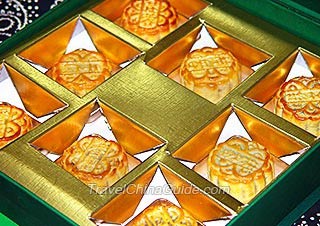 |
| Moon cakes, the special food for the Mid-Autumn Festival |
Eating Moon CakesAs with every Chinese holiday, the Mid-Autumn Festival has its own special food. People eat moon cakes at Mid-Autumn Festival. The moon cake is a kind of cookie with various fillings and on the surface are printed different artistic patterns depicting the story of Chang E flying to the moon. People treated this kind of food as one of the sacrificial offerings to the moon in the old days. Today, it has become an indispensable food while appreciating the bright moon for every family. Moon cakes come in various flavors which change according to the region but common fillings are nuts, sugar, sesame, ham and egg yolk.
As the moon cake is round in shape, it symbolizes the reunion of a family, so it is easy to understand how the eating of moon cakes under the round moon can inspire the missing of distant relatives. Nowadays, people present the moon cakes to relatives and friends to demonstrate that they wish them a long and happy life.
| this picture | ||||||||||||||||||||||||||||||||||||||||||||||||||||||||||||||||||||||||||||||||||||||||||||||||||||||||||||||||||||||||||||||||||||||||||||||||||||||||||||||||||||||||
|---|---|---|---|---|---|---|---|---|---|---|---|---|---|---|---|---|---|---|---|---|---|---|---|---|---|---|---|---|---|---|---|---|---|---|---|---|---|---|---|---|---|---|---|---|---|---|---|---|---|---|---|---|---|---|---|---|---|---|---|---|---|---|---|---|---|---|---|---|---|---|---|---|---|---|---|---|---|---|---|---|---|---|---|---|---|---|---|---|---|---|---|---|---|---|---|---|---|---|---|---|---|---|---|---|---|---|---|---|---|---|---|---|---|---|---|---|---|---|---|---|---|---|---|---|---|---|---|---|---|---|---|---|---|---|---|---|---|---|---|---|---|---|---|---|---|---|---|---|---|---|---|---|---|---|---|---|---|---|---|---|---|---|---|---|---|---|---|---|
 Mid-Autumn Festival decorations in Beijing |
||||||||||||||||||||||||||||||||||||||||||||||||||||||||||||||||||||||||||||||||||||||||||||||||||||||||||||||||||||||||||||||||||||||||||||||||||||||||||||||||||||||||
|
||||||||||||||||||||||||||||||||||||||||||||||||||||||||||||||||||||||||||||||||||||||||||||||||||||||||||||||||||||||||||||||||||||||||||||||||||||||||||||||||||||||||

HTML Comment Box is loading comments...

Tidak ada komentar:
Posting Komentar