Sabtu, 31 Maret 2012

Mid-Autumn Festival

In China people always celebrate Moon Festival or Mooncake Festival or Zhongqiu Festival, not only in China people in Indonesia also celebrate this. The festival is held on the 15th day of the eighth month in the Chinese calendar .
 In 2012 Mid-Autumn Festival falls on September 30. People enjoy one day off on that day which is usually connected with the weekend. The 2012 Mid-Autumn Day is connected with the National Day holiday (October 1 - 7), so people enjoy an eight-day holiday from September 30 to October 7. The long holiday with pleasant autumn weather becomes a peak time for travel. Welcome to China and explore the traditional folk customs of this interesting festival! Schedule of Mid-Autumn Festival in recent years is offered in the table on the right.


Introduction to Mid-Autumn Festival


Falling on the 15th day of the 8th month according to Chinese lunar calendar, the Mid-Autumn Festival is the second grandest festival after the Spring Festival in China. The festival takes its name from the fact that it is always celebrated in the middle of the autumn season. The Festival is also known as the Moon Festival, as at that time of the year the moon is at its roundest. On this day, family members gather to appreciate the bright full moon, eat moon cakes at night, express strong yearnings toward their homes and think of family members who live far away.


Legend about the Festival

Stories of the Mid-Autumn Festival

Houyi and Chang'e

Celebration of the Mid-Autumn Festival is strongly associated with the legend of Houyi and Chang'e, the Moon Goddess of Immortality. Tradition places these two figures from Chinese mythology at around 2200 BCE, during the reign of the legendary Emperor Yao, shortly after that of Huangdi. Unlike many lunar deities in other cultures who personify the moon, Chang'e simply lives on the moon but is not the moon herself.
There are many variants and adaptations of the legend of Chang'e that frequently contradict each other. However, most versions of the legend involve some variation of the following elements: Houyi, the Archer, an emperor, either benevolent or malevolent, and an elixir of life.
One version of the legend states that Houyi was an immortal and Chang'e was a beautiful young girl, working in the palace of the Jade Emperor (the Emperor of Heaven, 玉帝 pinyin:Yùdì) as an attendant to the Queen Mother of the West (the Jade Emperor's wife). Houyi aroused the jealousy of the other immortals, who then slandered him before the Jade Emperor. Houyi and his wife, Chang'e, were subsequently banished from heaven. They were forced to live on Earth. Houyi had to hunt to survive and became a skilled and famous archer.
At that time, there were ten suns, in the form of three-legged birds, residing in a mulberry tree in the eastern sea. Each day one of the sun birds would have to travel around the world on a carriage, driven by Xihe, the 'mother' of the suns. One day, all ten of the suns circled together, causing the Earth to burn. Emperor Yao, the Emperor of China, commanded Houyi to use his archery skill to shoot down all but one of the suns. Upon completion of his task, the Emperor rewarded Houyi with a pill that granted eternal life. Emperor Yao advised Houyi not to swallow the pill immediately but instead to prepare himself by praying and fasting for a year before taking it.Houyi took the pill home and hid it under a rafter. One day, Houyi was summoned away again by Emperor Yao. During her husband's absence, Chang'e, noticed a white beam of light beckoning from the rafters, and discovered the pill. Chang'e swallowed it and immediately found that she could fly. Houyi returned home, realizing what had happened he began to reprimand his wife. Chang'e escaped by flying out the window into the sky.
Houyi pursued her halfway across the heavens but was forced to return to Earth because of strong winds. Chang'e reached the moon, where she coughed up part of the pill.Chang'e commanded the hare that lived on the moon to make another pill. Chang'e would then be able to return to Earth and her husband.
The legend states that the hare is still pounding herbs, trying to make the pill. Houyi built himself a palace in the sun, representing "Yang" (the male principle), in contrast to Chang'e's home on the moon which represents "Yin" (the female principle). Once a year, on the night of the Mid-Autumn Festival, Houyi visits his wife. That is the reason why the moon is very full and beautiful on that night.
This description appears in written form in two Western Han dynasty (206 BC-24 AD) collections; Shan Hai Jing, the Classic of the Mountains and Seas and Huainanzi, a philosophical classic.
Another version of the legend, similar to the one above, differs in saying that Chang'e swallowed the pill of immortality because Peng, one of Houyi's many apprentice archers, tried to force her to give the pill to him. Knowing that she could not fight off Peng, Chang'e had no choice but to swallow the pill herself.
Other versions say that Houyi and Chang'e were still immortals living in heaven at the time that Houyi killed nine of the suns. The sun birds were the sons of the Jade Emperor, who punished Houyi and Chang'e by forcing them to live on Earth as mortals. Seeing that Chang'e felt extremely miserable over her loss of immortality, Houyi decided to find the pill that would restore it. At the end of his quest, he met the Queen Mother of the West, who agreed to give him the pill, but warned him that each person would only need half a pill to regain immortality. Houyi brought the pill home and stored it in a case. He warned Chang'e not to open the case, and then left home for a while. Like Pandora in Greek mythology, Chang'e became curious. She opened up the case and found the pill, just as Houyi was returning home. Nervous that Houyi would catch her, discovering the contents of the case, she accidentally swallowed the entire pill, and started to float into the sky because of the overdose.
Some versions of the legend do not refer to Houyi or Chang'e as having previously been immortals and initially present them as mortals instead.
There are also versions of the story in which Houyi was made king as a reward for killing nine of the suns and saving the people. However, King Houyi became a despot who either stole a pill of immortality from the Queen Mother of the West or learned that he could make such a pill by grinding up the body of a different adolescent boy every night for a hundred nights. Chang'e stole the pill and swallowed it herself, either to stop more boys being killed or to prevent her husband's tyrannical rule from lasting forever.

The Hare or The Jade Rabbit

According to tradition, the Jade Rabbit pounds medicine, together with the lady, Chang'e, for the gods. Others say that the Jade Rabbit is a shape, assumed by Chang'e herself. The dark areas to the top of the full moon may be construed as the figure of a rabbit. The animal's ears point to the upper right, while at the left are two large circular areas, representing its head and body.


Customs on Mid-Autumn Day

Different customs have evolved in different areas regarding the Mid-Autumn Festival. The most significant customs are to appreciate and offer sacrifice to the round bright moon and eat moon cakes. Other activities like dragon dancing and doing obeisance to the moon are also considered highly important.
 Appreciating and Offering Sacrifice to the Moonlight:
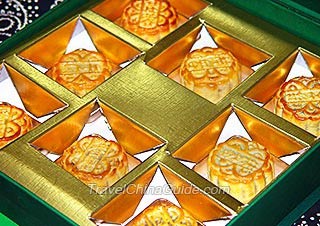
Moon cakes, the special food for the Mid-Autumn Festival.
Moon cakes, the special food for
the Mid-Autumn Festival
Since ancient times, Chinese emperors offered sacrifices to the sun in the spring and the moon in autumn. Especially in the Zhou Dynasty (11th century BC - 221 BC), the big incense burn table was arranged and all kinds of food were offered in sacrifice that day. However, appreciating the moon became more popular in the Tang (618 - 907) and Song Dynasties (960 - 1279). Many famous poems for praising the moon on the night of the festival were created during those periods. In the Ming Dynasty (1368 - 1644), the Moon Altar was built for the purpose of sacrifice to the moon on the Mid-Autumn Festival.Today, sacrifice has been replaced by a simple appreciation of the moon. Members of a family usually sit around a table eating and talking to their heart content and at the same time admiring the bright moon. While looking up the moon, people will think of their relatives afar and good wishes are expressed in their mind.
 Eating Moon CakesAs with every Chinese holiday, the Mid-Autumn Festival has its own special food. People eat moon cakes at Mid-Autumn Festival. The moon cake is a kind of cookie with various  fillings and on the surface are printed different artistic patterns depicting the story of Chang E flying to the moon. People treated this kind of food as one of the sacrificial offerings to the moon in the old days. Today, it has become an indispensable food while appreciating the bright moon for every family. Moon cakes come in various flavors which change according to the region but common fillings are nuts, sugar, sesame, ham and egg yolk.
As the moon cake is round in shape, it symbolizes the reunion of a family, so it is easy to understand how the eating of moon cakes under the round moon can inspire the missing of distant relatives. Nowadays, people present the moon cakes to relatives and friends to demonstrate that they wish them a long and happy life.
this picture
Mid-Autumn Festival
Mid-Autumn Festival decorations in Beijing

Mid-Autumn Festival
Moon Cakes.jpg
Mooncakes, often eaten during the festival


HTML Comment Box is loading comments...

Sabtu, 24 Maret 2012

Cheung Chau Bun Festival

Unless you've visited Hong Kong, chances are you haven't heard of Cheung Chau, a tiny, dumbbell-shaped island located about 12 kilometers south of the Hong Kong mainland. A fishing community that depends almost solely on the sea for its living, Cheung Chau is a curious mix of the modern and the traditional. Water taxis and ferries compete with sampans for space in the crowded harbor. (Visitors who take the one hour ferry ride from the mainland are often surprised to discover that motorized vehicles are not allowed on the island). But what makes Cheung Chau truly distinct is that it holds the world's only annual bun festival.
 this a competitor of bun festival :D


The Cheung Chau Bun Festival is one of Hong Kong's wackiest and best. Set on the small island of Cheung Chau, each year thousands of tourists descend on the island's lone village to watch hundreds of men scramble up the side of a 60ft 'bun tower' and pluck off plastic buns. The basic idea of the Cheung Chau bun climb is to yank off more buns than your competitors until all of the buns have been pulled off. Although toned down somewhat in recent years the competition is still frenetic and at times violent.

The Cheung Chau Bun festival is said to have its origins in scaring away evil spirits, how or why nobody seems to remember, but the event continues.

The traditional bun climb came to a tragic end in 1978, when a tower collapsed, injuring thirty climbers in the process. The event was then banned for the following 26 years. Reintroduced in 2005, the new event is somewhat tamer than the original. Previously, any number of aggressive, barehanded climbers would be involved on a tower cobbled together by local villagers. A recipe for disaster. Nowadays the final climb is restricted to twelve people, all of whom are safely secured in harnesses, and the tower is also reinforced with steel. Somewhat bizarrely, the original Chinese buns have been replaced with plastic replicas, apparently it's safer.

The Bun Climb is the finale of a larger festival and will be held at midnight of the main day (yearly dates below), although preliminary rounds will be held thought the week before. You can even try out your own climbing skills with a number of practise bun towers set up and instructors provided.

Another major part of the festival is the Cheung Chau Festival parade, when floats and dragon dances fill the street. The highlight of the parade is groups of children who are dressed up as gods, hoisted up on a 5ft pole and made to look like they're floating down the streets.

The Cheung Chau Bun Festival is one of Hong Kong's wackiest and best. Set on the small island of Cheung Chau, each year thousands of tourists descend on the island's lone village to watch hundreds of men scramble up the side of a 60ft 'bun tower' and pluck off plastic buns. The basic idea of the Cheung Chau bun climb is to yank off more buns than your competitors until all of the buns have been pulled off. Although toned down somewhat in recent years the competition is still frenetic and at times violent.

The Cheung Chau Bun festival is said to have its origins in scaring away evil spirits, how or why nobody seems to remember, but the event continues.

The traditional bun climb came to a tragic end in 1978, when a tower collapsed, injuring thirty climbers in the process. The event was then banned for the following 26 years. Reintroduced in 2005, the new event is somewhat tamer than the original. Previously, any number of aggressive, barehanded climbers would be involved on a tower cobbled together by local villagers. A recipe for disaster. Nowadays the final climb is restricted to twelve people, all of whom are safely secured in harnesses, and the tower is also reinforced with steel. Somewhat bizarrely, the original Chinese buns have been replaced with plastic replicas, apparently it's safer.

The Bun Climb is the finale of a larger festival and will be held at midnight of the main day (yearly dates below), although preliminary rounds will be held thought the week before. You can even try out your own climbing skills with a number of practise bun towers set up and instructors provided.

Another major part of the festival is the Cheung Chau Festival parade, when floats and dragon dances fill the street. The highlight of the parade is groups of children who are dressed up as gods, hoisted up on a 5ft pole and made to look like they're floating down the streets.

Festival of the Bun Hills
That's right, a bun festival. Also known as the "Festival of the bun hills," the four-day celebration includes parades, opera performances, and children dressed in colorful costumes. But the most spectacular feature by far is the bun towers - large bamboo structures several stories high, piled with sweet buns. The bun towers are located in front of the Pak Tai temple, built in 1783 to commemorate the Pak Tai, the Taoist God of the Sea. There are several temples in Hong Kong honoring the Pak Tai who, according to legend, threw the prince of evil out of heaven. Of greater importance to Cheung Chau's inhabitants, however, is his reputed role in driving away pirates who had launched a series of attacks on the island. According to local lore, the attacks ceased once the temple was built.

Racing For Buns
The buns, which have been blessed, are handed out to the people on the final day of the festival. Traditionally, men competed in a race to climb up the towers and grab as many buns as possible. In 1978, one of the towers collapsed, injuring several people. The tragic accident forced authorities to cancel the competition. However, organizers revived the competition in 2005. To ensure the safety of participants and spectators, the towers are now made of steel, covered with a bamboo scaffolding to look more authentic. Prospective bun-climbers must take a training course to learn basic mountaineering skills. At the end of the training period, twelve finalists are chosen to compete in the bun scrambling competition. Following the individual race, several teams compete in a relay.

Beginning in 2007, replica buns have been used in the bun scrambling competition. This is to ensure the competitor's safety, as real buns could become slippery in wet weather. However, festival-goers will still be able to collect buns from the three main bun towers.

Origins of the Cheung Chau Bun Festival
The origins of the bun festival are unclear. According to one source, it commemorates the islanders killed by pirates, and whose spirits may still be wandering the island. As with the Hungry Ghost Festival, islanders provide food and burnt paper offerings to placate these wondering souls. It is probably also designed to pay tribute to Pak Tai. The festival falls just before the start of the fishing season, so honoring the god is one way to ensure fair weather and a good catch.

If You Go...
In 2011, the main action takes place on Tuesday, May 10th, with the colorful Piu Sik (Floating Colours) parade in the afternoon and the bun scrambling competition commencing at 11:30 pm. To prepare for the festival, the whole island goes vegetarian for three days ahead of time - even McDonalds sells vegetarian burgers. If you're planning to visit Hong Kong in May, it's well worth a side trip to the island to take in this unusual celebration. In the meantime, here are some Chinese bun recipes for you to enjoy.
HTML Comment Box is loading comments...

Sabtu, 17 Maret 2012

QingMing in China

In China people always celebrate qing ming , in Indonesia people said Ceng Beng. Chinesse people always celebrate this. Qingming, which means clear and bright in Chinese, falls on April 5th this year. It is both the fifth term in the traditional lunar calendar and a festival to hold memorial ceremonies for the dead. It is a time to express one's grief for lost relatives. An ancient elegiac poem described a grievous woman. It read that vines were tangled in vain and weeds crept in the graveyard, and her husband slept there lonely. It was so difficult for her to endure and her only wish was to reunite with him after death.

People often go to sweep and weed graves with the entire family and take a walks in the countryside. Therefore, in Tang Dynasty, the habit of taking an excursion on this day was developed. At this time, spring returns and dominates the earth again. The feel of growing life is in the air, with sap ascending in trees and buds bursting. The willow branches inserted on each gate add vigor and vitality to the surroundings, but it actually means more than that. This custom can be traced back to over one thousand years ago.

During the Period of spring and autumn in the Jin Kingdom, one of the King's sons was called Chong Er. Jealous of his talent, a concubine falsely accused him of rebellion to make her son the crown prince. As a result, he had no choice but to flee with several officials. They hid themselves in a mountain and went hungry for quite some time. An official named Jie Zitui took great pain to cut some flesh from his thigh and cooked it for Chong Er. When the fact was known the young master was moved to tears and knelt down in gratitude. Jie replied his best repayment should be a just king. They lived a cold life of starvation for three years until the evil concubine died. Many soldiers were sent to look for him and to escort him back home. Going into the carriage, he saw an official packed an old mat onto a horse, he said laughingly, 'what on earth is the use of that? Throw it away!' Jie Zitui heard it and sighed, 'It is hardship that can be shared with his majesty but not prosperity.' As a result, he went away quietly and lived in seclusion with his old mother.

As Chong Er became king, he rewarded many people but he forgot Jie Zitui. He did not realize it until he was reminded. However, his invitation was refused and he became angry. Soldiers were ordered to burn up the mountain to force Jie to come out. Finally they found Jie and his mother scorched under a willow. He would rather die than yield to power. Chong Er was so overwhelmed with regret that he ordered people to hold memorial ceremony for Jie. Therefore, in memory of Jie, every year on that day people mourned for him and ate cold meals the day before. Later the custom of inserting willow branches on gates was also added.

Kamis, 08 Maret 2012

Easter in Chinesse Culture

In China many people celebrate easter. Because in China many people religion is Christian Chatolic.And easter is an International holiday that is celebrated in China as well. Even beyond the religious implications, Easter has many significances in the Chinese culture.

For many, Easter is a mark of the coming of spring. While ancient Chinese generally celebrate the coming of spring with Chinese New Years, the passing of the spring equinox is yet another reason to celebrate.

The three most common symbols that are associated with Easter in the West are: the Easter egg, rabbits, and baby chicks. All hold significance in the Chinese culture as well. In one of the creation stories that comes to us from ancient China, the world was created from an egg of chaos. Rabbits and chicks can be seen in many pieces of art, often there to symbolize life and birth.

From olden times, the art of painting on eggs has been part of the Chinese culture. Eggs would be drained and then fine line art depicting women, sceneries, and other images of beauty would grace the exterior. Jade and wood would be smoothed and carved into eggs to symbolize the "dragon egg". All these would be given as gifts in wishes of growth and many children.

But even beyond the commercialized aspects of Easter today, Chinese also celebrate the Christian rising of Christ. Perhaps even before the United States became known as the melting pot of cultures and religions, China held many, if not all, the known religions of the world. Much of these other religions entered China by way of the Silk Road and trade with other countries.

Thus, from very early on, Christianity has been part of the Chinese Culture, as many other religions of the world.

In order to wish someone a "Happy Easter" in Chinese, one of the ways you might say it is: fu huo jie kuai le. Literally translated it means "happy festival for the sign life".

Easter In China

Now people in china prepare abaout easter.  Now i will tell abaout people do.
When you’re in a country that doesn’t officially celebrate Easter, like China, sometimes you get nervous.  Will the Easter Bunny get his visa yanked at the last-minute?  Are you sure those chocolate eggs are melamine-free?   Is the holiday even legal here?
Well, we had those same concerns too, but finally decided China’s gonna love Easter!
Good Friday
First, start your Easter right, with a large order of “Holy Fries” for Good Friday.  Weren’t chips Jesus’ favorite snack?  Even if they weren’t, they’ll go great with your Friday fish.

Sabtu, 03 Maret 2012

Autumn Festival

Celebration of the Mid-Autumn Festival is strongly associated with the legend of Houyi and Chang'e, the Moon Goddess of Immortality. Tradition places these two figures from Chinese mythology at around 2200 BCE, during the reign of the legendary Emperor Yao, shortly after that of Huangdi. Unlike many lunar deities in other cultures who personify the moon, Chang'e simply lives on the moon but is not the moon herself.
There are many variants and adaptations of the legend of Chang'e that frequently contradict each other. However, most versions of the legend involve some variation of the following elements: Houyi, the Archer, an emperor, either benevolent or malevolent, and an elixir of life.
One version of the legend states that Houyi was an immortal and Chang'e was a beautiful young girl, working in the palace of the Jade Emperor (the Emperor of Heaven, 玉帝 pinyin:Yùdì) as an attendant to the Queen Mother of the West (the Jade Emperor's wife). Houyi aroused the jealousy of the other immortals, who then slandered him before the Jade Emperor. Houyi and his wife, Chang'e, were subsequently banished from heaven. They were forced to live on Earth. Houyi had to hunt to survive and became a skilled and famous archer.
At that time, there were ten suns, in the form of three-legged birds, residing in a mulberry tree in the eastern sea. Each day one of the sun birds would have to travel around the world on a carriage, driven by Xihe, the 'mother' of the suns. One day, all ten of the suns circled together, causing the Earth to burn. Emperor Yao, the Emperor of China, commanded Houyi to use his archery skill to shoot down all but one of the suns. Upon completion of his task, the Emperor rewarded Houyi with a pill that granted eternal life. Emperor Yao advised Houyi not to swallow the pill immediately but instead to prepare himself by praying and fasting for a year before taking it.[3] Houyi took the pill home and hid it under a rafter. One day, Houyi was summoned away again by Emperor Yao. During her husband's absence, Chang'e, noticed a white beam of light beckoning from the rafters, and discovered the pill. Chang'e swallowed it and immediately found that she could fly. Houyi returned home, realizing what had happened he began to reprimand his wife. Chang'e escaped by flying out the window into the sky.[3]
Houyi pursued her halfway across the heavens but was forced to return to Earth because of strong winds. Chang'e reached the moon, where she coughed up part of the pill.[3] Chang'e commanded the hare that lived on the moon to make another pill. Chang'e would then be able to return to Earth and her husband.[citation needed]
The legend states that the hare is still pounding herbs, trying to make the pill. Houyi built himself a palace in the sun, representing "Yang" (the male principle), in contrast to Chang'e's home on the moon which represents "Yin" (the female principle). Once a year, on the night of the Mid-Autumn Festival, Houyi visits his wife. That is the reason why the moon is very full and beautiful on that night.[3]
This description appears in written form in two Western Han dynasty (206 BC-24 AD) collections; Shan Hai Jing, the Classic of the Mountains and Seas and Huainanzi, a philosophical classic.[4]
Another version of the legend, similar to the one above, differs in saying that Chang'e swallowed the pill of immortality because Peng, one of Houyi's many apprentice archers, tried to force her to give the pill to him. Knowing that she could not fight off Peng, Chang'e had no choice but to swallow the pill herself.[citation needed]
Other versions say that Houyi and Chang'e were still immortals living in heaven at the time that Houyi killed nine of the suns. The sun birds were the sons of the Jade Emperor, who punished Houyi and Chang'e by forcing them to live on Earth as mortals. Seeing that Chang'e felt extremely miserable over her loss of immortality, Houyi decided to find the pill that would restore it. At the end of his quest, he met the Queen Mother of the West, who agreed to give him the pill, but warned him that each person would only need half a pill to regain immortality. Houyi brought the pill home and stored it in a case. He warned Chang'e not to open the case, and then left home for a while. Like Pandora in Greek mythology, Chang'e became curious. She opened up the case and found the pill, just as Houyi was returning home. Nervous that Houyi would catch her, discovering the contents of the case, she accidentally swallowed the entire pill, and started to float into the sky because of the overdose.
Some versions of the legend do not refer to Houyi or Chang'e as having previously been immortals and initially present them as mortals instead.[citation needed]
There are also versions of the story in which Houyi was made king as a reward for killing nine of the suns and saving the people. However, King Houyi became a despot who either stole a pill of immortality from the Queen Mother of the West or learned that he could make such a pill by grinding up the body of a different adolescent boy every night for a hundred nights. Chang'e stole the pill and swallowed it herself, either to stop more boys being killed or to prevent her husband's tyrannical rule from lasting forever

The Valentine's Day Story

As any Chinese grandmother will tell you, the ancient celebration of true love dates back centuries when Zhinu (織女 Weaving Girl) fell in love with a young farmer named Niulang 牛郎. Sadly, there is a classic complication - our heroine is the granddaughter of the Lady Queen Mother!
Even though the law strictly forbids relationships between mortals and immortals, the rebellious young couple fall in love and eventually marry anyway - when the unthinkable happens. Upon the discovery of their relationship, the Lady Queen Mother forces Zhinu to return to heaven, never to see Niulang again. Steadfast and true, Niulang refuses to give up. He flies to Zhinu's side (with the help of a magic ox) only to have the Lady Queen Mother step in once again. She uses a hairpin to draw the Milky Way across the sky to separate the couple forever. And there Zhinu and Niulang remain, separated for 364 days of the year - except for Chinese Valenine's Day - when the Lady Queen Mother takes pity on them by sending a flock of magpies to bridge the gap between the lovers and reunite them. Today, on Chinese Valentine's Day, school children are asked to search the heavens where Zhinu can be found in the star Vega east of the Milky Way, and for her beloved Niulang, who steadfastly waits for her in the constellation Aquila, west of the Milky Way. According to legend, on Chinese Valentines Day magpies can scarcely be seen, since they are spreading their wings to form the bridge in the heavens to reunite the couple once again. The evening of Chinese Valentine's Day is traditionally reserved for star gazing, and the classic retelling of the tale of Zhinu and Niulang ....